Managed Data Loss Prevention

Entrust your data security to XYunion's expertise, allowing your enterprise to focus entirely on business innovation

Data Classification Standards

Establish a scientific data classification system to achieve refined security management

Data Security Background

Data Classification
Standards

Restricted

Restricted data refers to data whose loss, damage, or unauthorized disclosure will cause devastating damage to the company's reputation or business position, triggering extreme financial, reputational, and legal losses

Internal

Internal data refers to data whose loss, damage, or unauthorized disclosure only has specific importance within the company, therefore not causing significant business, financial, or legal losses

Confidential

Confidential data refers to data whose loss, damage, or unauthorized disclosure will seriously damage the company's reputation or business position, leading to significant financial, reputational, and legal losses

Public

Public data poses no risk to the company even if widely disseminated

Based on data classification governance foundation, modern MDLP needs to achieve precision strategy, continuous operations, and risk visualization triple goals

Core Values

Solve enterprise security pain points, provide comprehensive security protection

Security Challenges Facing Enterprises

Pain Points Faced by Enterprises

Rigid DLP strategies cannot respond to dynamic business changes, with security and efficiency always in opposition.

Our Security Solution Value

Value Provided by XYunion

  • Comprehensive Data Identification

    As part of Data Security Governance (DSG), identify organizational classification results and ensure correct mapping to DLP engineering control methods

  • Build DLP Operations Model

    Help organizations build DLP operations models, optimize strategies based on event feedback and business changes, and assess DSG framework updates

  • Proactive Threat Discovery

    Recommend organizations conduct regular scans to proactively discover unmanaged sensitive data left in the "shadow" and generate corresponding DLP strategies

  • Precise Definition

    Precisely define necessary response actions for DLP strategies

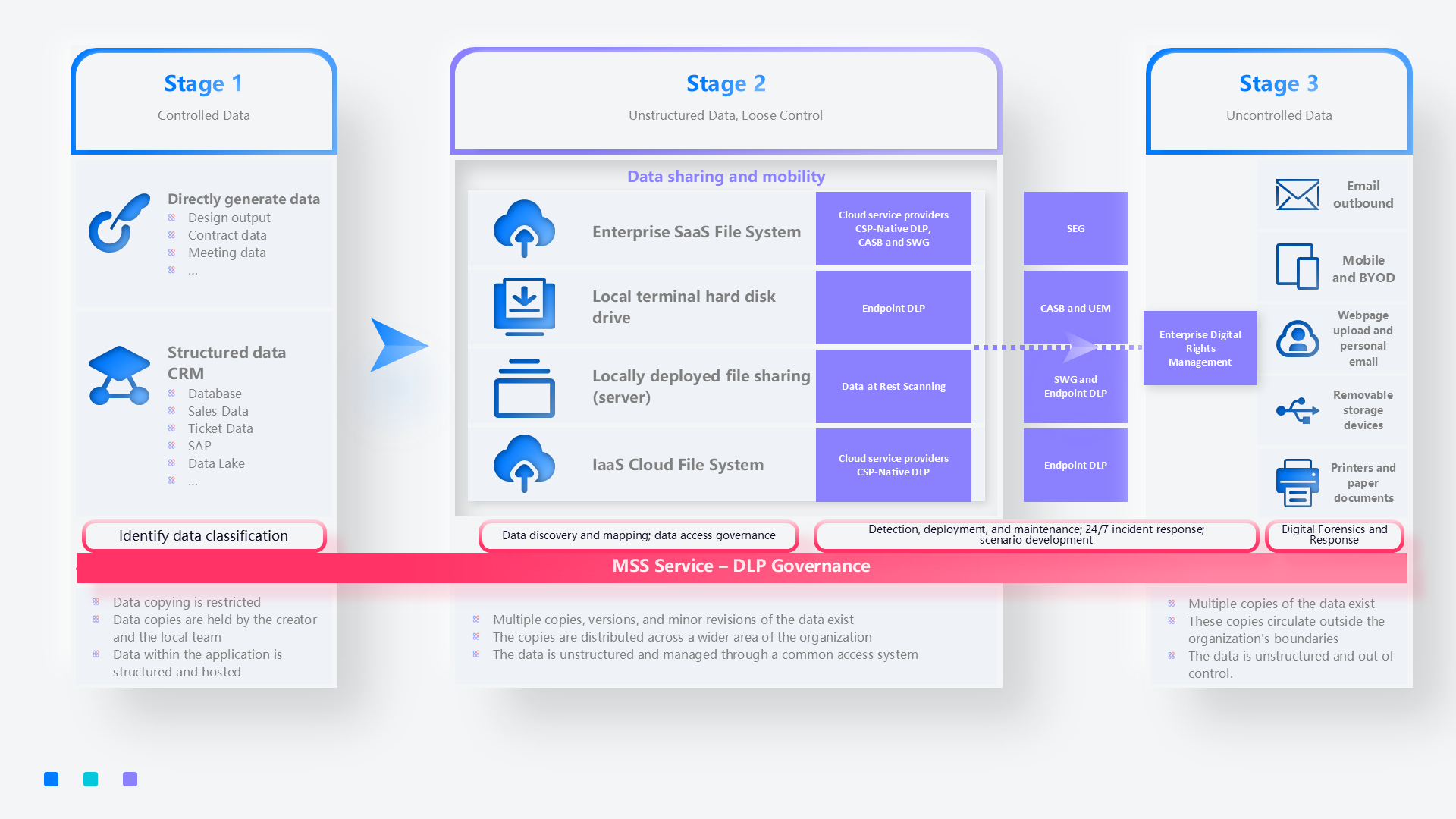
DLP Governance

Control points in enterprise data lifecycle

Data Loss Prevention Solution

How to Deploy DLP

Simple and efficient five-step method to quickly achieve data security protection

1

Discover Data

  • In Use
  • In Transit
  • At Rest
2

Assess Content

  • Is it sensitive data?
  • Contains specific phrases?
  • Conforms to specific type?
3

Associate Context

  • Who is the data operator?
  • Where does the operation occur?
  • When does the operation occur?
  • What operation is the user trying?
4

Compare Policy

  • Prohibit operation
  • Allow operation
    (under specific conditions)
  • Allow operation
    (unconditionally)
5

Execute Action

  • Allow operation
  • Block operation
  • Delete data
  • Encrypt data
  • Report incident